Food Banks Face Rising Demand as Families Struggle to Pay Bills
Heather Black, who leads United Way Worldwide 211 System Strategy, says many families are racking up credit card debt to buy groceries
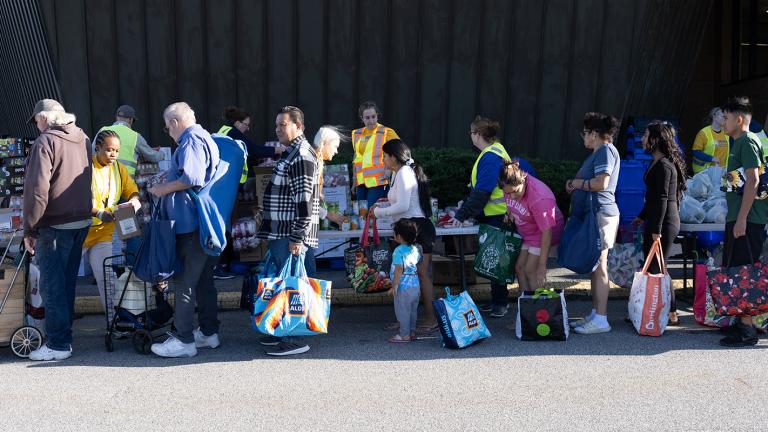
People waiting in line at a food bank operated by United Way of Southeastern Connecticut, which also has five mobile food pantries with onsite food distribution.
Read the full New York Times article on how almost half of Americans struggle to pay for at least one of their basic needs.
Rising grocery bills and dwindling federal food benefits — the first driven by tariffs and war, the second by government budget cuts enacted, in part, by President Trump’s signature tax-cut-and-spending law — are pushing struggling families to food pantries to help bridge the gap.
An NBC News survey this month of 48 of the largest food banks — representing 35 states and Washington, D.C. — found that nearly three-quarters reported increases in the number of people coming to their sites over the past year. The rise is coinciding with midterm elections that could prove to be a referendum on Mr. Trump’s economic stewardship.
The recent jump in food pantry traffic sits atop elevated demand from pandemic-era disruptions and inflation that had already widened the type of families dependent on help. Assistance that was once reserved for emergencies has become indispensable for many.
Overall, consumer prices are up 3.7 percent from a year earlier, according to the Bureau of Labor Statistics. Food costs jumped 2.5 percent over the past 12 months and about 30 percent from 2019 to 2025.
The result: Almost half of Americans struggle to pay for at least one of their basic needs, a study by the Pew Research Center found. Nearly three-quarters of lower-income adults reported difficulty covering the cost of groceries, housing, medical care or daily transportation.
Data from the 211 network, a national information and referral service for social services and other assistance, offers a more recent if narrow snapshot. The United Way, which supports the 211 network and handles about 60 percent of the referrals, reported at least a 20 percent spike in requests for food assistance last year in multiple states, including Louisiana, Texas, Maine, Michigan and Pennsylvania.
Heather Black, who leads United Way Worldwide 211 System Strategy, said some who reached out to 211 acknowledged they were racking up credit card debt to buy groceries.
Strengthening Food Security
United Way is connecting families to nutritious meals, expanding local food access, and building thriving communities.