A View From the Hill: Recovery and Resilience After Helene
When the floodwaters rose in Taylor’s Valley, Virginia, the elderly couple living near the river barely had time to react. The wife watched from upstairs as water filled their home. Her husband, caught downstairs, was swept several hundred yards downstream before clinging to a tree for hours in the rising dark. By the time he was rescued, Hurricane Helene had taken their home.
Meeting The Community Where They Are
In the weeks that followed, United Way of Southwest Virginia moved quickly. Using seed funding from United Way Worldwide, they launched the Citizen Recovery Program (CRP) to meet immediate needs that would have otherwise gone unanswered. “The needs were the full spectrum,” said Dan Rice, Disaster Recovery Coordinator. “Anything you can really think about, from bridges to basements, floodings to appliance losses.” At the same time, they organized a public fundraising effort to support long-term recovery.
The CRP, which is grant-funded, focused on urgent direct service. The County Funding Program, powered by community donations, supported infrastructure and longer-term needs. Together, these strategies allowed United Way to serve families across the disaster timeline. So far, the CRP has assisted 129 households recovering from Helene, delivering over $39,000 in support for everything from mattresses to food to temporary shelter. The county-directed Helene recovery fund has committed more than $2.2 million to long-term efforts across the region.
From Relief to Recovery
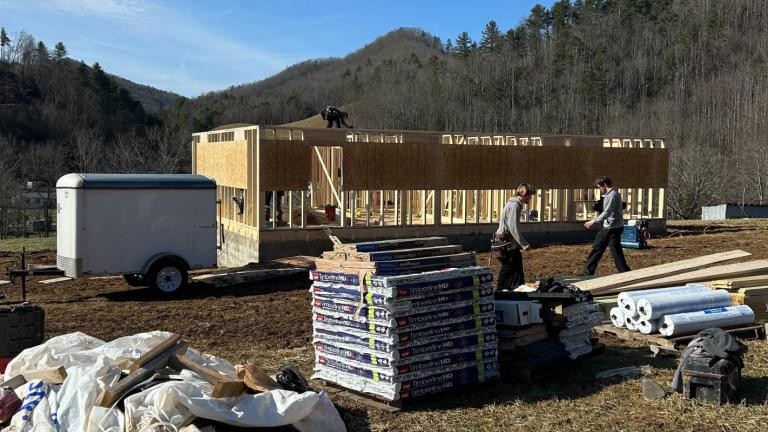
For the couple in Taylor’s Valley, this network of support changed their future. Trails to Recovery, a grassroots long-term recovery group supported through United Way’s county-level funding, secured a new property on higher ground. Volunteers from Mennonite Disaster Services constructed the new home. “There was one adult and three teenagers out there,” said Dan. “One day it’s a hole in the ground, the next there’s framing, then walls.” From their new porch, the couple can now look down the hill toward the woman’s childhood home.
One day it’s a hole in the ground, the next there’s framing, then walls.”
Their story reflects what United Way does best: mobilizing partners, directing donor dollars where they are needed most, and drawing on deep local experience to know who is right for the job.
James, an artist in Damascus, spent five months sleeping on a camp cot after the flood destroyed both his home and studio. When other forms of aid ran out, United Way stepped in. Through the CRP, he received a new mattress and direct support to restart recovery. “I’m sleeping better than I have in a long time,” he said.
A family of six lost their camper and all their belongings along the Clinch River. United Way helped with food, covered their first month’s rent in a new home, and provided new beds and bedding for the children. “The best thing that can turn a new house into a home is a nice warm bed of your very own,” one parent said.
Weathering Winter Storm Jett
The weekend after the CRP launched, Winter Storm Jett arrived. Heavy rains and flash flooding caused new damage in already weakened areas. Within United Way’s 21-county service area, 16 counties were affected by Helene, 6 by Jett, and 4 by both storms. “Those overlapping counties got hit twice,” Dan said. “In many cases, infrastructure weakened by Helene completely gave way during Jett.” United Way acted fast. Megan Parks, Executive Director, adjusted the CRP strategy to include households impacted by Jett. Applications quickly surged.
CRP support for Jett recovery has already reached 39 households, totaling over $34,000 in assistance. The county-level fund added another $340,000 toward that effort.
The timing tested the team’s flexibility. CRP staff pivoted from food and housing relief to repairing private bridges, supporting damaged septic systems, and helping families navigate multiple stages of recovery. While some were still tarping roofs from Helene, others were just beginning to assess damages from Jett.
Even now, United Way continues to answer the odd call for immediate relief, while advancing long-term recovery. “On average, it takes five years to fully recover from a disaster like Helene,” said Megan. “We’re one year in. The needs are still here. But so are we.” United Way isn’t going anywhere. From the earliest hours of crisis to the final mile of recovery, they are here for the long haul.
Disaster Recovery
Learn more about how United Way is helping communities rebuild and recover after disasters.